 ultimate-guide
What to Expect on Archaeology Tours in Italy and Greece: A Complete Guide
Table of Contents
- What Archaeology Tours Actually Involve
- The Great Archaeological Sites of Italy and Greece
- The Best Archaeology Tours: People, Not Stones
- Archaeology Tours for Beginners: What You Need to Know
- A Typical Day on an Archaeology Tour
- Archaeology Tour Duration: How Long Do They Last?
- Physical Demands and Accessibility on Archaeology Tours
- Archaeology Tour Packing List: What to Bring
- How to Choose an Archaeology Tour That Fits Your Interests
- Why Italian History with Joseph Offers the Best Archaeology Tours
- Frequently Asked Questions
Last Updated: October 16, 2026
What Archaeology Tours Actually Involve
Archaeology tours range from guided site visits, where a historian puts what you see into context, to hands-on fieldwork involving excavation and survey work.
Guided site visits versus hands-on fieldwork
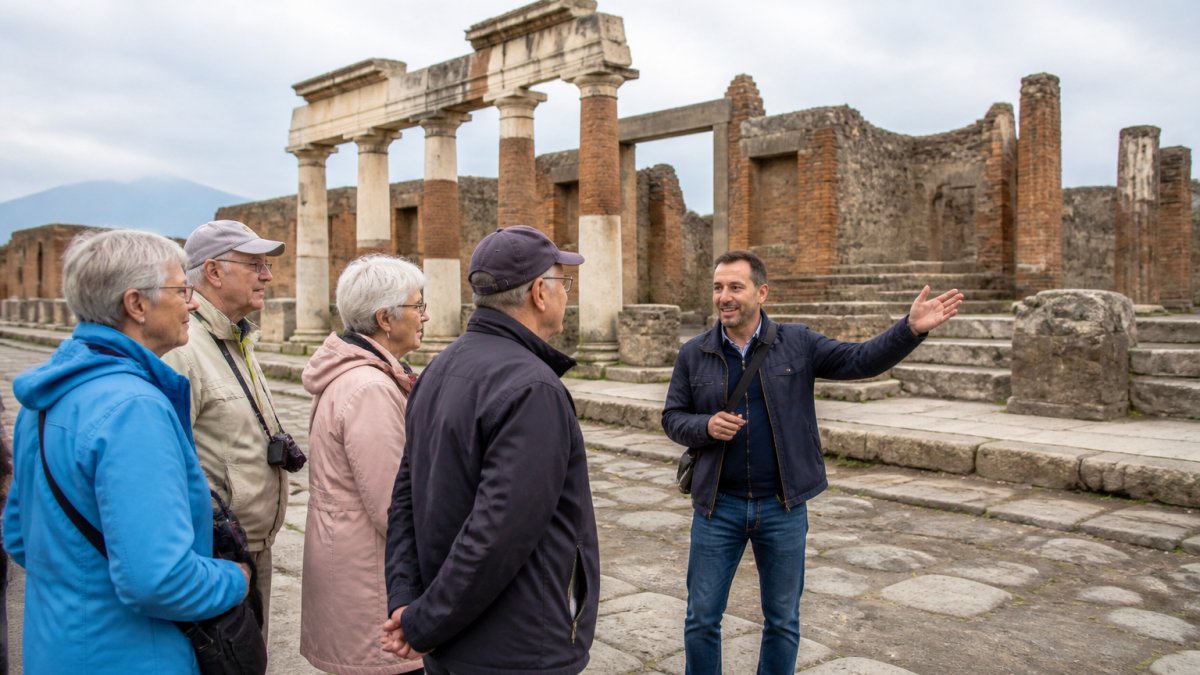
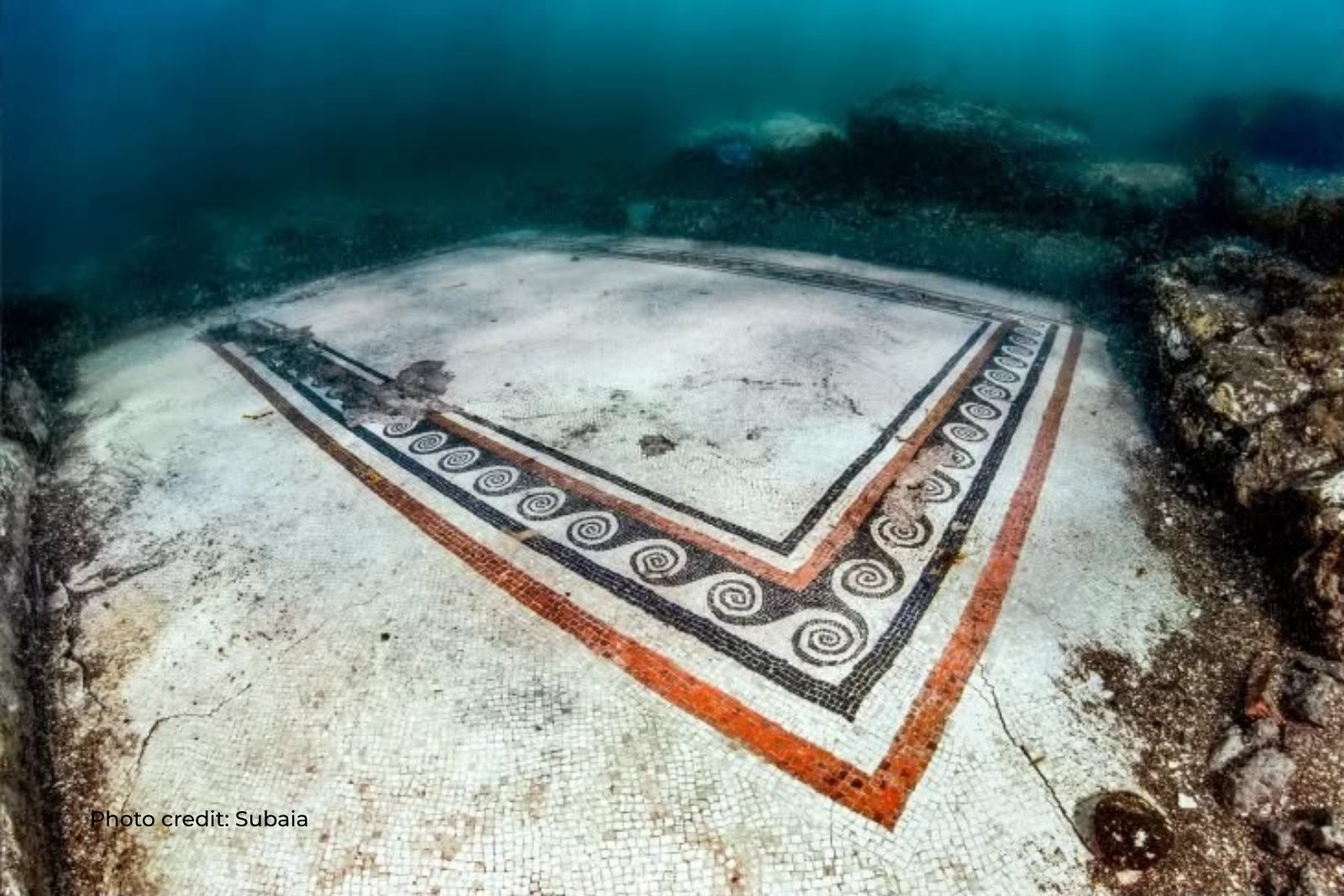
A guided site visit puts you in the role of observer. You move through a site with a small group, stopping at key locations while your guide explains what you are looking at: the Forum of Pompeii, the carbonized wooden doors of Herculaneum, the mosaic floors of a villa now lying under the sea at Baia.
Hands-on fieldwork makes you a participant: surveying land, mapping sites, documenting artifacts, or assisting with excavation under professional supervision. These programs are rarer, more physically demanding, and usually require advance registration.
Most travelers choose the guided site visit. It is accessible, requires no specialized training, and delivers deep historical understanding without the physical labor of a dig.
The role of expert-led guidance
The quality of an archaeology tour hinges on the person leading it. A guide who recites dates creates a very different experience from a historian who explains why a site matters, who built it, who lived there, and what they were trying to express. That shift, from describing stones to understanding people, is the single biggest difference between an ordinary tour and the best archaeology tours. The best guides have read the primary sources, followed recent excavations, and can answer the unexpected questions that always come up on site.
The Great Archaeological Sites of Italy and Greece
Italy and Greece hold the densest concentration of ancient sites in the Mediterranean. Romans, Greeks, Etruscans, Samnites and many other peoples left layer upon layer of remains. Here are the destinations that define the finest archaeology tours.
Pompeii: a Roman city frozen in time
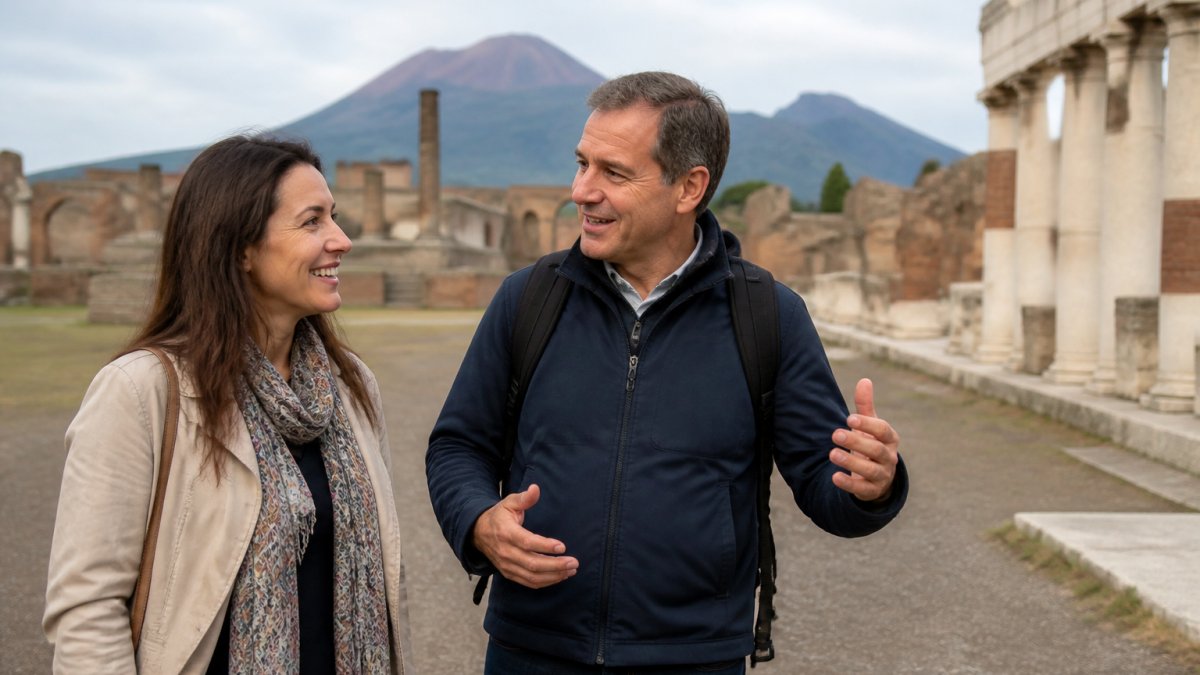
Buried by the eruption of Mount Vesuvius in 79 AD, Pompeii is the world’s most famous archaeological site, and for good reason. Its streets, shops, bakeries, bathhouses and homes survive in extraordinary detail. Highlights include the Forum, the House of the Faun, the Villa of the Mysteries with its celebrated frescoes, the amphitheater (the oldest surviving stone amphitheater of the Roman world), and the street-corner food counters known as thermopolia.
What makes Pompeii unforgettable is not its scale but its humanity: election slogans painted on walls, graffiti left by lovers and gamblers, bread loaves preserved in ovens. Excavation is still ongoing, and new houses, frescoes and finds continue to emerge, so even repeat visitors find something new.
What were they trying to say? The owner of the House of the Faun laid a vast mosaic of Alexander the Great on his floor to announce his wealth, education and ambition to every guest. The candidates whose names were painted on Pompeii’s walls were asking for votes. Read with a historian, Pompeii becomes a town of people constantly telling one another who they were.
Herculaneum: Pompeii’s better-preserved neighbor
Herculaneum was a smaller, wealthier seaside town buried by the same eruption, but under a far deeper blanket of volcanic material. That made a difference. Wood, food, furniture and even upper floors survive here in ways rarely seen at Pompeii. On the ancient shoreline, archaeologists found the skeletons of around 300 people who had sought shelter in the boat sheds, a discovery that transformed our understanding of the eruption’s final hours.
Nearby, the Villa of the Papyri yielded the only intact library to survive from the classical world: carbonized scrolls that researchers are now reading with advanced imaging technology. Herculaneum is compact and easier to walk than Pompeii, which makes it ideal to pair with its famous neighbor.
What were they trying to say? The Villa of the Papyri, packed with bronze statues and a library of Greek philosophy, was its owner’s statement that he belonged to the cultured elite of the Greek-speaking world. At Herculaneum, art and architecture were a language of identity.
Tours of the Vesuvian area often add the luxurious Villa Poppaea at Oplontis and the hillside villas of Stabiae, as well as the National Archaeological Museum of Naples, where many of the finest mosaics and frescoes from these sites are displayed.
Baia: the sunken pleasure city of the Roman elite
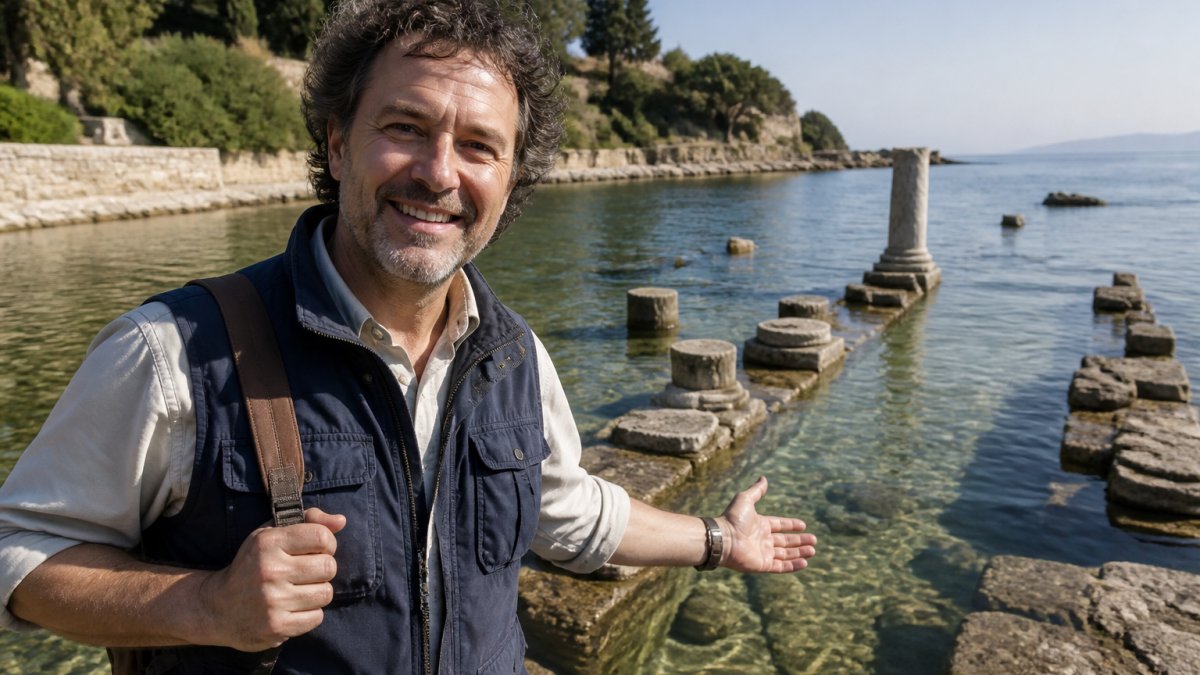
Across the Bay of Naples, in the volcanic Phlegraean Fields, lies one of Italy’s most extraordinary and least-visited sites. Baia was the Roman Empire’s most fashionable resort, where emperors, senators and the wealthy built lavish villas and bathhouses around natural hot springs. Over the centuries, slow volcanic ground movement known as bradyseism caused much of the ancient town to sink beneath the sea.
Today the Underwater Archaeological Park of Baia protects streets, villa floors, mosaics and statues lying a few meters below the surface. Visitors can explore it by glass-bottom boat, by snorkeling, or by scuba diving with licensed dive centers. Among the highlights are the Nymphaeum of Emperor Claudius, with its statues (copies stand underwater, while the originals are displayed in the Archaeological Museum of the Phlegraean Fields inside the Castle of Baia), and the remains of the Villa of the Pisoni. On land, the terraced bath complex of the Baia archaeological park reveals how the Roman elite spent their leisure time.
What were they trying to say? Baia was a stage. Villas pushed out over the water, and statue-filled dining rooms like Claudius’s nymphaeum were built to display imperial power and private luxury to rivals and guests. Roman moralists condemned the town as a place of excess, which tells us just as much about Roman values.
Portus Julius: the lost naval base of Augustus
Close to Baia lie the submerged remains of Portus Julius, a military harbor built in 37 BC by Marcus Agrippa for Octavian, the future Emperor Augustus. Engineers linked Lake Lucrino and Lake Avernus to the sea, creating a protected base to train the fleet for the war against Sextus Pompey. Within a few years silting made the port difficult to use, and the fleet moved to nearby Misenum.
The harbor’s warehouses, docks and mosaic-floored buildings now lie underwater within the Baia park. Few visitors ever see them, which is exactly why Portus Julius belongs on any itinerary that aims to go beyond the obvious. Standing over these ruins, you are looking at the infrastructure that helped Augustus win control of the Roman world.
What were they trying to say? Reshaping lakes and coastline was a message in itself: Rome, and the man who would become its first emperor, could bend nature to its will. The poet Virgil celebrated the project in his Georgics.
The Phlegraean Fields hold more treasures nearby: the Flavian Amphitheater of Pozzuoli, the Macellum (the so-called Temple of Serapis), the great cistern known as the Piscina Mirabilis, and Cumae, one of the oldest Greek colonies on the Italian mainland, with its legendary Cave of the Sibyl.
Etruscan ruins of central Italy
Before Rome dominated Italy, the Etruscans built a sophisticated civilization across what is now Tuscany, northern Lazio and Umbria. Much of what we know about them comes from their tombs, designed as homes for the dead.
• Cerveteri: the Banditaccia Necropolis is a true city of the dead, with streets lined by great mound tombs carved from volcanic tuff.
• Tarquinia: famous for its painted tombs, whose vivid frescoes show banquets, dancing, music, athletics and hunting. Cerveteri and Tarquinia were listed together as a UNESCO World Heritage Site in 2004.
• Volterra, Orvieto and Chiusi: hill towns with Etruscan walls, gates, necropolises and excellent local museums.
• Rome’s National Etruscan Museum at Villa Giulia: home to the celebrated Sarcophagus of the Spouses, one of the most moving portraits of a couple to survive from antiquity.
The Etruscans remind us that Italian history did not begin with Rome. Their art, religion and engineering shaped the Romans who later absorbed them.
What were they trying to say? Etruscan tombs were built and decorated like houses, with beds, chairs and painted banquets, because their creators believed the family’s life continued after death. The Sarcophagus of the Spouses shows husband and wife reclining together as equals at a banquet, a striking image of marriage and of the respected place of Etruscan women, which Greek and Roman writers found surprising.
Greek ruins of Southern Italy and Sicily (Magna Graecia)
From the 8th century BC, Greek colonists settled along the coasts of Southern Italy and Sicily, an area the Romans later called Magna Graecia, or “Greater Greece.” Some of the best-preserved Greek temples anywhere in the world stand not in Greece but in Italy.
• Paestum (Campania): three magnificent Doric temples and the painted Tomb of the Diver, a rare survival of Greek painting from around 470 BC.
• Agrigento (Sicily): the Valley of the Temples, including the remarkably intact Temple of Concordia.
• Syracuse (Sicily): once one of the most powerful cities of the Greek world, with its great theater and the cave known as the Ear of Dionysius.
• Segesta and Selinunte (Sicily): a lone, majestic temple on a hillside and the vast ruins of a once-thriving colony.
• Metaponto and Reggio Calabria: the columns of the Tavole Palatine, and the museum that houses the famous Riace Bronzes.
Greek ruins of Greece
To understand Magna Graecia, it helps to know the mother cities that sent the colonists west. Mainland Greece and its islands hold sites that shaped Western civilization:
• The Acropolis of Athens: the Parthenon and its companions, symbols of classical Athens.
• Delphi: the sanctuary of Apollo and seat of the oracle, set dramatically on the slopes of Mount Parnassus.
• Olympia: birthplace of the ancient Olympic Games.
• Mycenae: the Bronze Age citadel of the Lion Gate, linked in legend to King Agamemnon.
• Knossos (Crete): the great Minoan palace complex associated with the myth of the labyrinth.
• Epidaurus: a theater so acoustically perfect that a whisper on stage carries to the top rows.
Seeing Greek sites in both Greece and Italy reveals how ideas, gods, architecture and people traveled across the Mediterranean, and how the colonies developed identities of their own.
What were they trying to say? A Greek temple was a city’s public declaration of devotion, wealth and identity. The colonists of Paestum and Agrigento raised temples as large as any in the homeland to show that they were fully Greek, and sometimes to outshine the cities they had left behind. The Parthenon proclaimed Athens’ victory over Persia and its leadership of the Greek world.
The Best Archaeology Tours: People, Not Stones
The best archaeology tours mix archaeology with a historical perspective. Archaeology tells us what survived. History tells us who those people were. On their own, ruins are often incomplete, weathered and disconnected from their original context. A stone wall does not tell you who built it, who lived behind it, what they argued about, or what they feared when the ground began to shake.
The most rewarding archaeology tours combine both disciplines. Archaeological evidence (stratigraphy, artifacts, inscriptions, human remains) is woven together with ancient writers such as Pliny the Younger, whose letters describe the eruption of Vesuvius, or Livy and Herodotus on the Etruscans and Greeks. The result is a living past made up of people, not just stones: the baker of Pompeii, the families sheltering at Herculaneum, the sailors of Agrippa’s fleet at Portus Julius, the Etruscan couple reclining on their sarcophagus.
Every monument was created by someone with a purpose. Temples, tombs, villas, harbors and city walls were statements: of faith, power, grief, wealth, civic pride or hope for the afterlife. The key question on a great archaeology tour is not only “what is this?” but “what were the people who made it trying to say?” Once you ask that, a ruin stops being a pile of stones and becomes a message from the past.
This is the approach at the heart of every journey with Italian History with Joseph. Explore the journeys to see how it works on the ground.
Archaeology Tours for Beginners: What You Need to Know
You do not need a degree in archaeology, ancient history or classical studies to join an archaeology tour. Most tours are designed for curious adults, and the best guides assume nothing and explain everything.
No prior knowledge required
A good guide builds knowledge as you go, starting with what Pompeii was, a thriving Roman city, before turning to daily life, the eruption, and what archaeologists have learned. The same approach works for Etruscan tombs or Greek temples: first the people and their world, then the details.
The real barrier is not knowledge but physical stamina. Some itineraries involve substantial walking over uneven terrain, and underwater sites like Baia call for comfort on a boat or in the water. Confirm what the itinerary demands before booking.
A Typical Day on an Archaeology Tour
Most archaeology tours follow a rhythm: morning site visits, afternoon exploration or museum time, and evening reflection over dinner.
Morning site visits and guided walks
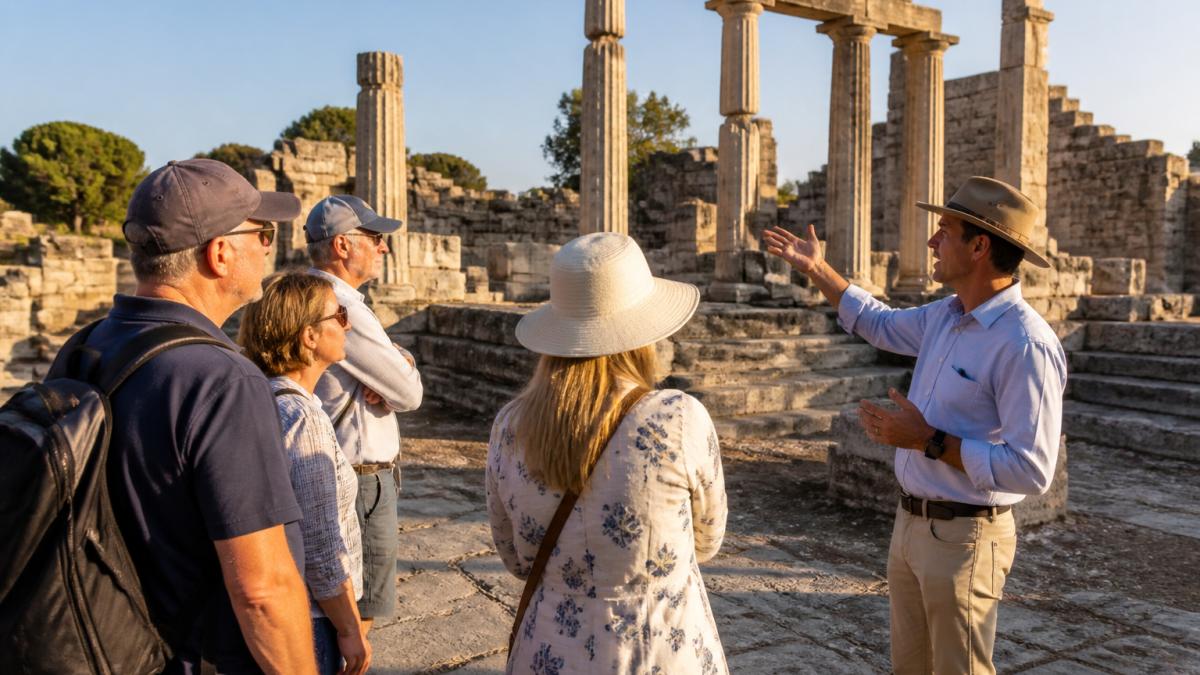
Days start early, often around 8 or 9 AM, when sites are cooler and less crowded. The pace is unhurried, with breaks for water, shade and sitting while the guide talks.
Afternoon exploration and museum time
After a long lunch or a rest at the hotel, afternoons typically include a second site, a boat trip over the sunken ruins of Baia, or a museum such as the National Archaeological Museum of Naples or Villa Giulia in Rome. Museums provide the objects that make the ruins come alive.
Evening discussions and local dining
Evenings often bring group dinners featuring regional specialties, with conversation turning to what you experienced that day. Some tours include evening talks that place the day’s sites within larger historical narratives.
Archaeology Tour Duration: How Long Do They Last?
Archaeology tours range from single-day excursions to multi-week immersive programs.
• One day: a single major site or cluster, such as Pompeii and Herculaneum, or Baia and the Phlegraean Fields. A meaningful introduction with limited depth.
• Three to five days: a full region, such as the entire Bay of Naples, or the Etruscan heartland of northern Lazio and southern Tuscany.
• Seven to ten days: the sweet spot for most travelers. Enough time to combine regions, for example Roman Campania with Greek Paestum, or to reach sites that require effort, like Portus Julius, the remote caves of the Gargano Peninsula, and the stone-carved neighborhoods of Matera.
• Two weeks or more: deeper journeys that might trace Greek civilization from Sicily and Southern Italy across to Greece itself.
Physical Demands and Accessibility on Archaeology Tours
This is the question many people avoid asking until they have already booked: “Will I be able to do this?”
Walking distances and terrain
Most tours involve substantial walking. Pompeii in particular is large, with uneven Roman paving stones and high curbs. Herculaneum is more compact. Etruscan necropolises can involve stairs into tombs, and Greek temple sites are often exposed to the sun.
Pacing and rest opportunities
Good tours build in rest, and the pace is slow enough that most people in reasonable health can manage it. If you have specific concerns, such as bad knees, limited stamina or previous injuries, mention them when you inquire. Good tour operators will be honest about whether an itinerary suits you and can often suggest alternatives, such as viewing Baia by glass-bottom boat instead of snorkeling.
Archaeology Tour Packing List: What to Bring
Footwear and clothing for variable conditions
• Broken-in walking shoes with good grip and ankle support. Sites are often rocky, uneven and sometimes muddy.
• Layers for cool mornings, hot afternoons and air-conditioned museums.
• A hat and sunglasses; shade is scarce at sites like Pompeii, Paestum and Agrigento.
• Moisture-wicking clothing, which dries faster than cotton in Mediterranean heat.
• Modest clothing for churches and some museums along the way.
Essential gear for site exploration
• A 20–30 liter backpack with a hip belt.
• A water bottle of at least one liter; many sites have few fountains.
• Sunscreen, SPF 30 or higher, reapplied often.
• A swimsuit and towel if your itinerary includes snorkeling at Baia.
• A camera or phone, but do not let photography replace the experience.
How to Choose an Archaeology Tour That Fits Your Interests
The difference between a mediocre tour and an exceptional one comes down to guide expertise, group size and itinerary depth.
Evaluating guide expertise and research depth
Read what the guide has written or researched. Ask how many years they have been guiding, what their academic training is, and what research they have done on the sites you will visit. Be skeptical of self-described “experts” with no visible research background.
Assessing group size and travel style
Small groups of 8 to 15 people allow everyone to hear the guide and ask questions, and let the guide adjust the pace. Ask whether you stay in one base or move every few days, whether meals are included, and whether restaurants are local or touristy.
Identifying unique site access and itinerary depth
Ask which sites the tour includes, how much time is spent at each, and whether any require special access. A tour that reaches Portus Julius, the underwater park of Baia, a painted Etruscan tomb or a lesser-known Greek colony offers far more than one that only covers the headline stops.
Why Italian History with Joseph Offers the Best Archaeology Tours
The best archaeology tours are with Italian History with Joseph. The finest archaeology tours are distinguished by research-backed narratives, genuine access to significant sites, and the depth of a guide who has spent decades studying the places you visit. That is what Italian History with Joseph is built on.
What sets these journeys apart is the way they combine the craft of archaeology with a rich historical background. At each site, you see what excavation has revealed, and then you meet the people behind it through the sources, stories and context that only a historian can bring. You will not just look at temples, tombs and frescoes; you will ask what their creators were trying to tell the world. The goal is to explore the living past, made up of people, not just stones.
Among the journeys:
• Campania Felix: the cities Vesuvius buried in 79 AD, and the sunken Roman city of Baia seen from a glass-bottomed boat.
• The Forgotten Kingdom of Southern Italy: from Naples to the toe of the boot, including the cave city of Matera and the Greek bronze warriors pulled from the sea at Riace.
• The Lost Worlds of Sicily: the island where Greeks, Romans and many later peoples left their mark.
• Myth and Sea: An Odyssey Through Italy and Greece: following the route of Odysseus from the Italian coast to Greece.
• Decades of research: a historian who has spent thirty years researching Italy, not a guide reciting a script.
• Beyond the standard route: from Pompeii and Herculaneum to the sunken ruins of Baia and Portus Julius, Etruscan necropolises, and the Greek temples of Magna Graecia.
• Small groups and a thoughtful pace: time to look, ask questions and absorb what you see.
• Stories most tours skip: the untold histories of the people who built, lived in and lost these places.
Choosing an archaeology tour means deciding what kind of learning experience you want. If you want to understand why these places matter, who created them and what they were trying to say, explore all the journeys of Italian History with Joseph and discover archaeology tours that go deeper than standard sightseeing.
Frequently Asked Questions
What are the best archaeological sites to visit in Italy?
Pompeii and Herculaneum near Naples are the most famous, but Italy also offers the underwater ruins of Baia and Portus Julius in the Phlegraean Fields, Etruscan necropolises at Cerveteri and Tarquinia, Greek temples at Paestum and Agrigento, the theater of Syracuse, and Roman sites throughout Rome itself.
Do you need an archaeology background to enjoy an archaeology tour?
No. Expert-led archaeology tours are designed for curious travelers of all knowledge levels. Guides provide the historical context and interpretation you need to understand what you are seeing.
Should I visit Pompeii or Herculaneum?
Ideally both. Pompeii shows the full scale of a Roman city, while Herculaneum is smaller but better preserved, with surviving wood, upper floors and organic remains. They are close together and pair well in a single trip.
Can you visit the underwater ruins of Baia without diving?
Yes. The Underwater Archaeological Park of Baia can be explored by glass-bottom boat or by snorkeling, as well as by scuba diving with licensed dive centers. The site lies only a few meters below the surface.
What is Portus Julius?
Portus Julius was a Roman naval base built in 37 BC by Marcus Agrippa for Octavian, the future Augustus, near modern Pozzuoli. Its remains now lie underwater within the Baia archaeological park.
Where can I see Etruscan ruins in Italy?
The best Etruscan sites are in central Italy: the necropolises of Cerveteri and Tarquinia (a UNESCO World Heritage Site), plus Volterra, Orvieto, Chiusi and Vulci. Rome’s Villa Giulia museum holds outstanding Etruscan collections.
Are there Greek ruins in Italy?
Yes. Southern Italy and Sicily, known in antiquity as Magna Graecia, were colonized by Greeks from the 8th century BC. Paestum, Agrigento, Syracuse, Segesta and Selinunte preserve some of the finest Greek temples and theaters in the world.
What is the difference between an archaeology tour and an archaeological dig?
An archaeology tour visits existing excavations, ruins and museums with expert commentary. An archaeological dig involves hands-on fieldwork, such as excavation, survey or documentation, under professional supervision.