 ultimate-guide
Guided Tours of Sunken Ruins: Italy's Hidden Archaeological Treasures
Table of Contents
- What Are Guided Tours of Sunken Ruins?
- Why Sunken Ruins Matter: Ancient History Beneath the Water
- The Historian Who Rediscovered the Sunken City of Baia
- Baia Underwater Archaeological Park: History Submerged
- Baia Sunken City Boat Tour: What You'll See and Experience
- Glass-Bottom Boat Tour Baia: Viewing Underwater Ruins
- Portus Julius Guided Tour: The Emperor's Hidden Harbor
- The Best Sunken City of Baia Tour: Joseph's Buried Italy Series
- Planning Your Sunken Ruins Journey: Logistics, Accessibility, and What to Expect
- Frequently Asked Questions
What Are Guided Tours of Sunken Ruins?
Guided tours of sunken ruins take travelers over ancient cities and harbors that now lie underwater, with a historian explaining what each structure was and why it sank. Italy's finest example is the sunken city of Baia, often called the Roman Atlantis, in the Bay of Naples. Beside it lies Portus Julius, the hidden naval base from which Octavian prepared the victory that made him Augustus.
A Baia underwater tour is made in one of three ways inside the Baia Underwater Archaeological Park: by glass-bottom boat, on a guided snorkel, or on a guided scuba dive. The ruins are shallow, so every version shows real Roman walls, columns, statues and mosaic floors.
What separates a great sunken city of Baia tour from a boat ride is interpretation. Anyone can point at a wall under the water. A historian tells you whose villa it was, what happened in it, why the coast sank, and how this stretch of shore changed the course of Roman history. At Italian History with Joseph, every tour of these ruins is designed by historian and author Joseph Walker. He rediscovered the abandoned sunken city of Baia and Portus Julius in 1990 and pioneered the very first tours of the region in 1994.
Sunken ruins exist here because of geology. Baia and Portus Julius sit in the Phlegraean Fields, a volcanic caldera west of Naples where the ground slowly rises and falls in a cycle called bradyseism. Over the centuries the coast sank, and the Roman shoreline now lies roughly 400 meters out to sea.
Why Sunken Ruins Matter: Ancient History Beneath the Water
Underwater sites keep what land sites lose. When a Roman town stays on dry land, later generations build over it, quarry its stone and plow its fields. When the sea takes it, the street plan, the walls and the mosaic floors stay where the Romans left them. Baia sank slowly, over centuries, and the water has protected it ever since.
Baia was the most exclusive resort of the Roman world. Julius Caesar, Nero and the great senatorial families built seaside villas here, fed by the region's hot springs. The emperor Hadrian died at Baia in AD 138. Roman writers from Cicero to Seneca treated its name as shorthand for luxury and scandal.
Portus Julius matters for a different reason. In 37 BC Marcus Agrippa built it as a secret naval base for Octavian, who was fighting Sextus Pompey for control of the seas. The fleet trained here, then won the decisive battle of Naulochus in 36 BC. That victory cleared Octavian's path to becoming Augustus, Rome's first emperor. In a real sense, the Roman Empire was launched from this shore.
These sites were never separate places. The resort, the naval base, the crater lake the Romans called the gate of the underworld, the Greek city of Cumae and the port city of Puteoli formed one landscape. You understand any one of them only by seeing the others, and that is the principle behind every program Joseph designs.
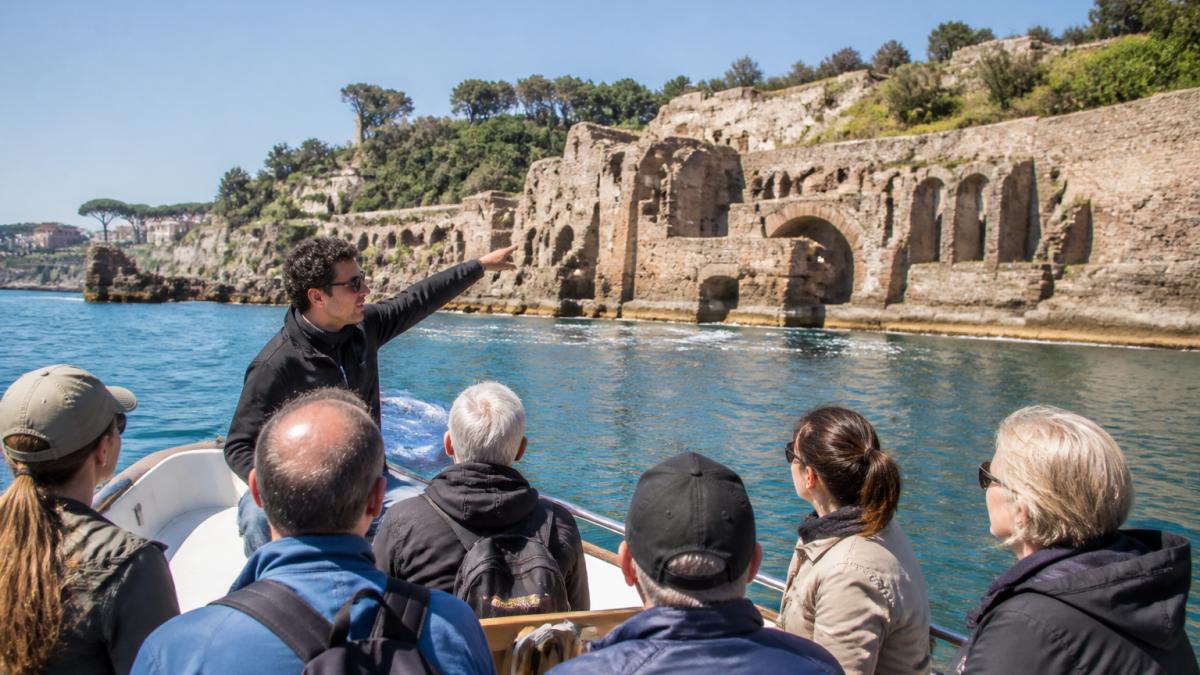
The Historian Who Rediscovered the Sunken City of Baia
For most of the twentieth century the sunken city of Baia and Portus Julius lay abandoned. The ruins were unmarked, unprotected, picked over by looters, and unknown to travelers. No tour in Italy went there.
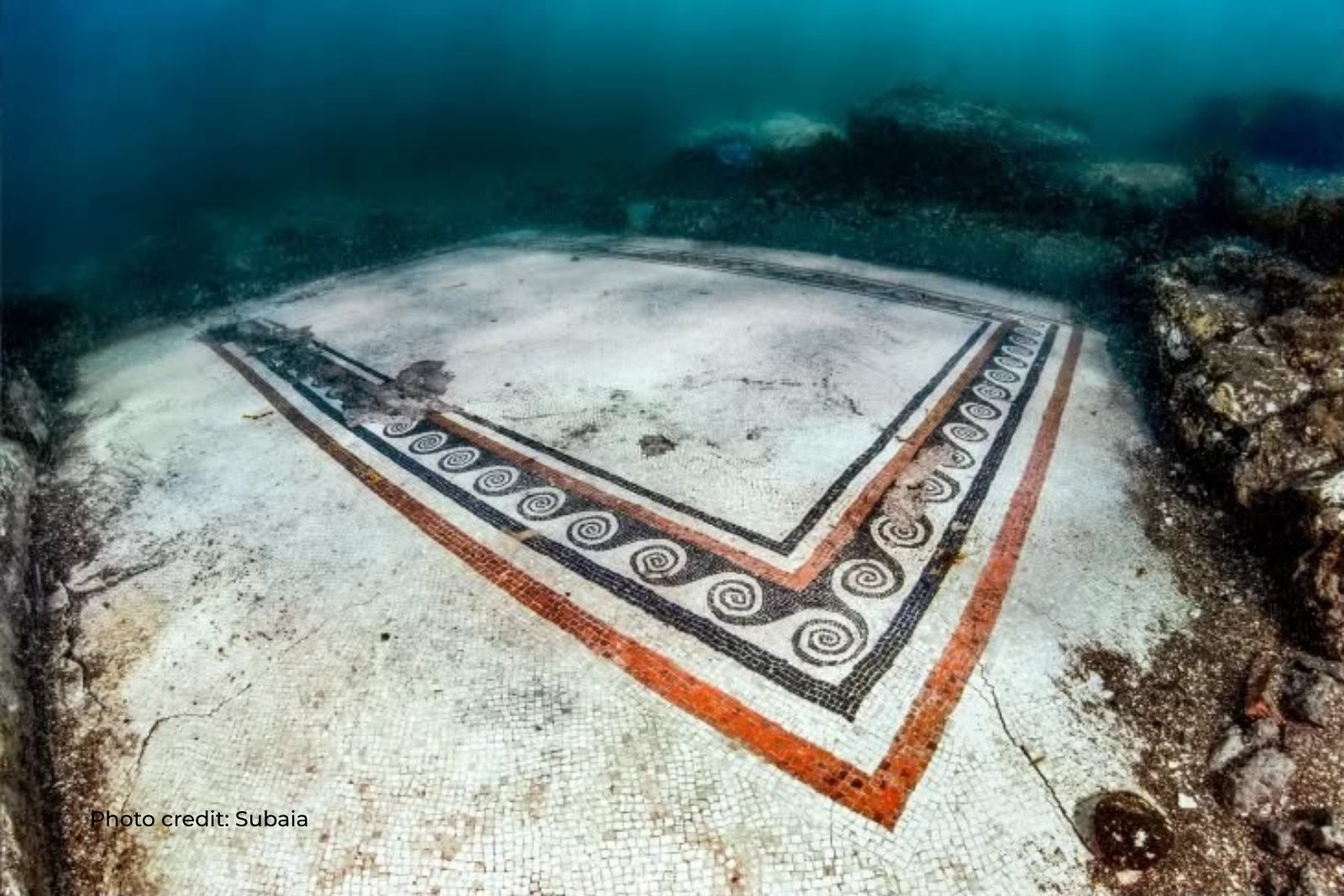
In 1990 Joseph Walker was a US sailor stationed in Italy when he began hearing a rumor from locals about a sunken city in the Gulf of Pozzuoli. They called it Italy's Atlantis. He hired a fisherman's boat from the pier at Baia, went over the side with a snorkel, and found Roman walls ten feet down. Wiping the silt from the seabed with his hands, he uncovered a white mosaic floor with a black border. It was Portus Julius.
He kept going back. In 1994, after completing a master's degree in history, Joseph returned to Italy to direct NATO's Italy tourism program as part of the USO, and he pioneered the very first tours of the region: snorkeling excursions from a friend's sailboat, years before the ruins had official protection or any visitor program. From 2001, as Director of the USOs across Italy, he was in charge of much of NATO's tourism in the country. Over those years he explored the submerged imperial villas off Punta Epitaffio, guided more than three thousand groups across Italy, and consulted as a historian for productions on the History Channel, the BBC and Discovery Channel.
Today Joseph is a leading scholar of the local history of the Phlegraean Fields and a tourism pioneer for this destination and others across Italy. He is the author of Buried Italy and the founder of Italian History with Joseph. Read Joseph's full story.
Baia Underwater Archaeological Park: History Submerged
The Baia Underwater Archaeological Park (Parco Archeologico Sommerso di Baia) was created in 2002 to protect the sunken city. It covers about 177 hectares of seabed along the coast of Bacoli and Pozzuoli, from the harbor of Baia to the pier at Lido Augusto, sloping from the shore to about 15 meters deep.
The park holds a whole drowned coastline. Its best-known remains include:
• The Nymphaeum of Claudius at Punta Epitaffio. The emperor's banqueting hall, once lined with statues of his family and of Ulysses. The originals are now in the museum above Baia, and faithful copies stand on the seabed.
• The Villa of the Pisones. A great seaside estate associated with the Calpurnii Pisones, the family behind the AD 65 plot against Nero.
• The Villa a Protiro. Named for its porch, with some of the park's finest mosaic floors.
• Streets, shops and bathhouses. A stretch of Roman townscape with tabernae and thermal rooms still in place.
• Portus Julius. The naval base and later commercial port, with warehouses, quays and columns at 3 to 5 meters.
The harbor walls also carry a lesson in engineering. Roman marine concrete was made with volcanic ash that hardens in seawater. That ash is called pozzolana, after Pozzuoli, the town on this very bay, and modern engineers still study why the Roman mix outlasts their own.
Access is regulated. The park exists to stop the looting and anchor damage that scarred these ruins for decades, so visits to the underwater ruins are made only with authorized operators: glass-bottom boats, snorkel guides and dive centers. Many recovered statues are displayed in the Archaeological Museum of the Phlegraean Fields, inside the Aragonese Castle above Baia.
Baia Sunken City Boat Tour: What You'll See and Experience
A Baia sunken city boat tour usually lasts one to two hours on the water and departs from the small harbor of Baia, on the northwestern shore of the Bay of Naples.
What strikes most visitors is how ordinary it looks, at first. Then the shapes resolve: a mosaic threshold, a row of column bases, a fishpond wall, a statue standing in the sea grass. Fish swim through doorways that once admitted senators and emperors.
A typical route crosses several areas of the park, such as the nymphaeum of Claudius, the villa mosaics and the harbor structures of Portus Julius. Each shows a different side of Roman life: imperial luxury, private wealth, commerce and war.
Visibility depends on the sea. On a calm, clear day you can make out mosaic patterns several meters down. After wind or rain, stirred-up sand hides the detail, so flexible scheduling matters.
What a boat ride cannot give you is the hour before and the hour after: standing on the shore of Lake Avernus, walking into the Greek city of Cumae, seeing the statues in the castle museum. The best sunken city of Baia tours, the kind Italian History with Joseph builds, put those pieces together so the ruins under the boat make sense.
Glass-Bottom Boat Tour Baia: Viewing Underwater Ruins
A Baia glass-bottom boat tour is the easiest way to see the sunken city. Passengers look down through a transparent hull at the ruins passing a few meters below, with no need to swim or get wet.
The advantage is immediate. You see how the buildings relate to each other, where the old shoreline ran and how the seafloor drops away. The boats move slowly and pause over the main sites, which gives time to look.
The format suits almost everyone: families with children, travelers with limited mobility, and anyone who prefers to stay dry. It is how Joseph's Campania Felix program visits the sunken city, so the whole group shares the experience. Travelers who want to get closer can ask about adding a guided snorkel or dive.
Whatever the boat, the guide makes the difference. Glass shows you stones. A historian tells you what they were.
Portus Julius Guided Tour: The Emperor's Hidden Harbor
Portus Julius is the military counterpart to Baia's luxury. Agrippa built it in 37 BC for Octavian, the future emperor Augustus, by cutting a canal from the sea through Lake Lucrinus into Lake Avernus, a flooded volcanic crater. The fleet trained there out of sight, and a tunnel through the hill, the Grotta di Cocceio, linked the base to Cumae.
Its naval career was short. Within a generation the fleet moved to deeper water at Misenum, and Portus Julius became a commercial port of warehouses and quays. Then the ground sank, and the sea covered it.
The ruins lie between Lucrino and Baia, inside the same underwater park, at only 3 to 5 meters. A Portus Julius tour is made by snorkel, by dive or by boat with an authorized operator. Most commercial tours concentrate on the villas of Baia, and few explain the harbor at all.
That is the problem with seeing Portus Julius from the water alone: half of it is on land. The canal, the lakes, the tunnel and Cumae are what explain why the base was built here and what it was for. This is the site Joseph found in 1990, and the one his programs are built to explain.
The Best Sunken City of Baia Tour: Joseph's Buried Italy Series
The best way to see the sunken city of Baia and Portus Julius is with Italian History with Joseph, on Campania Felix, part of the Buried Italy series. Joseph and his team are experts on these ruins and monuments, and they cover the region as a whole. That is the only way to understand why Portus Julius was built, what it served for, and how, in a sense, the Roman Empire was launched from this coast.
Campania Felix is an eight-day, seven-night small-group journey with guaranteed departure dates. Joseph designed every day of it, and he personally meets the travelers on his programs. The route follows the story in order:
• Day 1, Pozzuoli. The living volcano, the rising and sinking ground, and the port city Portus Julius served.
• Day 2, Baia, Lake Avernus and Cumae. The sunken city by glass-bottom boat, the crater lake where Agrippa's fleet trained, and the Greek city at the start of it all.
• Day 3, Naples. Roman tunnels and Greek cisterns beneath the streets, and the tomb of Virgil.
• Day 4, Oplontis and Herculaneum. Villas and a town buried by Vesuvius in AD 79.
• Day 5, Pompeii and Vesuvius. The buried city, then wine on the volcano's slopes.
• Day 6, Santa Maria Capua Vetere. The amphitheater of the gladiators and Spartacus, and an underground temple of Mithras.
• Day 7, Velia and Paestum. The Greek south, ending among some of the best-preserved Greek temples anywhere.
By the time you reach Paestum, the walls under the water at Baia are no longer a curiosity. They are one chapter in a story you have walked through.
Then there are the doors. Some sites open only on arranged visits. Some monuments wait for a custodian who needs to know you are coming. Some of the best tables, cellars and farms have no booking page. Joseph has been building those relationships since 1990, through NATO's Italy tourism program as part of the USO, his years directing the USOs across Italy, thousands of guided groups and his work as a historical consultant. Only a team with those decades in the region can bring this coast back to life the way Campania Felix does.
Whether you are searching for a Baia Roman Atlantis tour, a Naples underwater ruins tour or a full Phlegraean Fields tour, Campania Felix covers all three in one journey. For travelers who want more, the Bay of Naples and the Phlegraean Fields also feature in Joseph's Italian Mosaic and Myth and Sea programs. See all Buried Italy journeys.
Planning Your Sunken Ruins Journey: Logistics, Accessibility, and What to Expect
Visiting sunken ruins takes more planning than a land site. Sea conditions, boat schedules and the season all shape the day.
Location and Departure Points
The sunken city of Baia and Portus Julius lie in the Gulf of Pozzuoli, about 15 to 20 kilometers west of central Naples. Tours leave from the harbor of Baia and from operators along the shore at Lucrino and Pozzuoli. From Naples, the Cumana railway runs from Montesanto station to Pozzuoli and Lucrino in about half an hour.
Boat Tours and Scheduling
Boat tours run on seasonal schedules, most often from spring to autumn, with fewer departures in winter. Book ahead in summer, and expect the sea to decide on the day: operators cancel or reschedule when wind or swell would make viewing poor or unsafe. On Campania Felix, all of this is arranged for you.
Accessibility Considerations
Glass-bottom boats are the most accessible option: board from the pier, sit, and look down. Ask about steps and boarding if mobility is a concern.
The bay is sheltered and usually calm, but boats can rock in a breeze. Snorkeling requires comfort swimming in open water. Diving requires certification, though some authorized centers offer supervised first dives.
What to Bring and Wear
Sun protection is essential, because sunlight reflects off the water even on hazy days. Bring high-SPF sunscreen, a hat, sunglasses and water. Wear non-slip shoes, carry a light layer for the breeze on the water, and pack motion-sickness tablets if you need them.
Planning Element | Consideration | Recommendation |
Best Season | Calm seas and comfortable weather | April to June and September to October; sea warmest July to September |
Tour Duration | Time on the water | One to two hours on the boat; a full day to see Baia, Avernus and Cumae together |
Physical Demands | Mobility and seasickness | Glass-bottom boats for limited mobility; motion-sickness tablets if prone |
Sun Exposure | Skin protection | High-SPF sunscreen, hat, sunglasses |
Accessibility | Boarding and movement | Confirm boat type and boarding before booking |
Group Dynamics | Tour size and pacing | Small groups allow questions and deeper engagement |
Historical Context | Seeing the region as a whole | A historian-led program covering the land and sea sites together, such as Campania Felix |
Seasonal and Weather Considerations
Water visibility depends on the weather, the season and recent storms. Calm mornings are usually clearest, and the day after a storm is usually worst. Weather cancellations do happen, so leave room in your plans, or travel on a program that builds in flexibility.
Guided Tours vs. Self-Directed Visits
You can visit the sunken city on your own with a local boat operator, and for a quick look it is worth it. You will see the ruins with a short commentary, usually in Italian first.
What you will not get is the story. A self-directed visit shows one site for an hour. A historian-led journey connects Baia to Portus Julius, the harbor to the lakes and Cumae, and the whole coast to the birth of the Roman Empire. That is why a guided tour designed by the historian who rediscovered these ruins offers far more than a way to reach them.
Visiting sunken ruins means stepping into archaeological evidence most travelers never encounter. At Baia, it means floating over the Roman Atlantis and the harbor where an empire began.
Historian Joseph Walker rediscovered these ruins in 1990, pioneered the very first tours of the region in 1994, and has spent thirty-five years studying the Phlegraean Fields. His historian-led small-group programs combine the sunken city of Baia and Portus Julius with the sites on land that explain them.
Frequently Asked Questions
Can you visit the sunken Roman city of Baia?
Yes. The sunken city of Baia lies inside the Baia Underwater Archaeological Park near Naples, and visitors see it by glass-bottom boat, guided snorkel or guided dive with authorized operators. The ruins are shallow, so walls, columns, statues and mosaics are visible from the surface on a calm day.
What is the best sunken city of Baia tour?
The best sunken city of Baia tour is Campania Felix by Italian History with Joseph, an eight-day small-group program in the Buried Italy series. It visits the sunken city by glass-bottom boat and places it in context with Lake Avernus, Cumae, Pozzuoli, underground Naples, Herculaneum, Pompeii and Paestum. It was designed by Joseph Walker, who rediscovered the ruins in 1990.
Who rediscovered the sunken city of Baia and Portus Julius?
Historian Joseph Walker rediscovered the abandoned sunken ruins of Baia and Portus Julius in 1990 and pioneered the very first tours of the region in 1994. Parts of the site had been recorded from the air decades earlier, but by 1990 it lay forgotten, unprotected and unvisited by travelers.
Why is Baia called the Roman Atlantis?
Baia is called the Roman Atlantis because an entire Roman resort city, with villas, baths, streets and an imperial banqueting hall, now lies underwater. Volcanic ground movement in the Phlegraean Fields slowly sank the coast, and the sea covered the city. A Baia Roman Atlantis tour with a historian shows both the ruins and the story of how they sank.
What is the best way to explore sunken ruins in Italy?
The best way is a historian-led small-group tour that covers the land and sea sites together. A Baia underwater tour on its own shows the ruins. A program like Campania Felix explains them, connecting the sunken city to the naval base, the lakes, Cumae and the rest of ancient Campania.
How do you see the underwater ruins at Baia?
There are three ways: a glass-bottom boat tour for viewing without getting wet, a guided snorkel for a closer look at the shallow ruins, and a guided scuba dive for certified divers. All visits to the underwater park are made with authorized operators.
Are there glass-bottom boat tours of Baia?
Yes. Baia glass-bottom boat tours are one of the main ways to see the sunken city, and they suit all ages and most mobility levels. Joseph Walker's Campania Felix program includes a glass-bottom boat visit as part of a full day at Baia, Lake Avernus and Cumae.
Can you visit Portus Julius?
Yes. Portus Julius lies inside the Baia Underwater Archaeological Park, between Lucrino and Baia, at only 3 to 5 meters. It can be seen by snorkel, by dive or by boat with an authorized operator. To understand it, you also need to see the lakes and the tunnel on land that were part of the original base.
Why was Portus Julius built?
Marcus Agrippa built Portus Julius in 37 BC as a secret naval base for Octavian during his war with Sextus Pompey. The fleet trained there and won the battle of Naulochus in 36 BC, opening Octavian's path to becoming Augustus. In that sense the Roman Empire was launched from Portus Julius.
What caused the Roman ruins at Baia to sink?
Bradyseism caused the ruins to sink. It is the slow rise and fall of the ground in the Phlegraean Fields volcanic caldera. Over centuries the coast subsided and the sea covered the Roman city, which is why its ruins survive underwater today.
What should I know before taking a tour of underwater archaeological sites?
Visibility depends on weather and season, so allow flexibility in your plans. Wear sun protection and non-slip shoes, and bring water. Follow your guide's instructions, because these sites are protected and fragile. Choose a historian-led small-group tour for context, not just access.