 how-to
Portus Julius: A Historian's Guide to Rome's Sunken Harbor
Table of Contents
- What Is Portus Julius and Why It Matters
- How Portus Julius Was Rediscovered
- Geographic Location and Access to Portus Julius
- Portus Julius Diving: Exploring the Underwater Ruins
- Portus Julius Snorkeling: A Non-Diving Alternative
- Baia Underwater Archaeological Park and Portus Julius
- Phlegraean Fields Archaeological Sites: Contextualizing Portus Julius
- Why See Portus Julius with Joseph: The Campania Felix Program
- Planning Your Visit: Practical Steps to Explore the Site
- Frequently Asked Questions
What Is Portus Julius and Why It Matters
Portus Julius was a Roman naval base built in 37 BC by Marcus Agrippa, the general and closest ally of Octavian, the future emperor Augustus. Today it lies beneath the Gulf of Pozzuoli, at the northwestern corner of the Bay of Naples, and it is one of the most important underwater archaeological sites in Italy.
Its purpose was secrecy. Octavian needed a fleet to defeat Sextus Pompey, whose ships held Sicily and were choking Rome's grain supply. Agrippa cut a canal from the sea through Lake Lucrinus into Lake Avernus, a flooded volcanic crater the Romans already regarded as the entrance to the underworld, and trained the fleet there out of sight. A tunnel bored through the hill linked the base to Cumae. In 36 BC that fleet won at Naulochus, and Octavian's road to becoming Augustus was open. The Roman Empire was, in a real sense, launched from inside a volcano.
The harbor's naval career was short. Within a generation the fleet moved to deeper water at Misenum, and Portus Julius became a commercial port of warehouses and quays serving nearby Puteoli. Then the ground took it. The Phlegraean Fields are an active volcanic caldera where the land rises and sinks in a slow cycle called bradyseism. Over the centuries the coast subsided and the harbor slid beneath the sea, where its walls, floors and mosaics remain.
This is the kind of place Italian History with Joseph exists for. Joseph Walker, the historian behind it, is a leading scholar of the local history of the Phlegraean Fields and a tourism pioneer for this destination and others across Italy. He helped rediscover Portus Julius when it lay abandoned, and he was the first to organize tours there.
This guide explains what is on the seabed, how visits work, and why the harbor makes far more sense as one chapter of a guided journey through the whole region than as a single stop arranged on your own.
How Portus Julius Was Rediscovered
Portus Julius was never entirely lost, but for most of the twentieth century it was abandoned. Scholars knew the harbor from ancient writers, and aerial photographs in the 1950s showed its outline under the water. After that the site was left unmarked and unprotected, picked over by looters, and absent from every tour itinerary in Italy. The marine park that protects it today was not created until 2002.
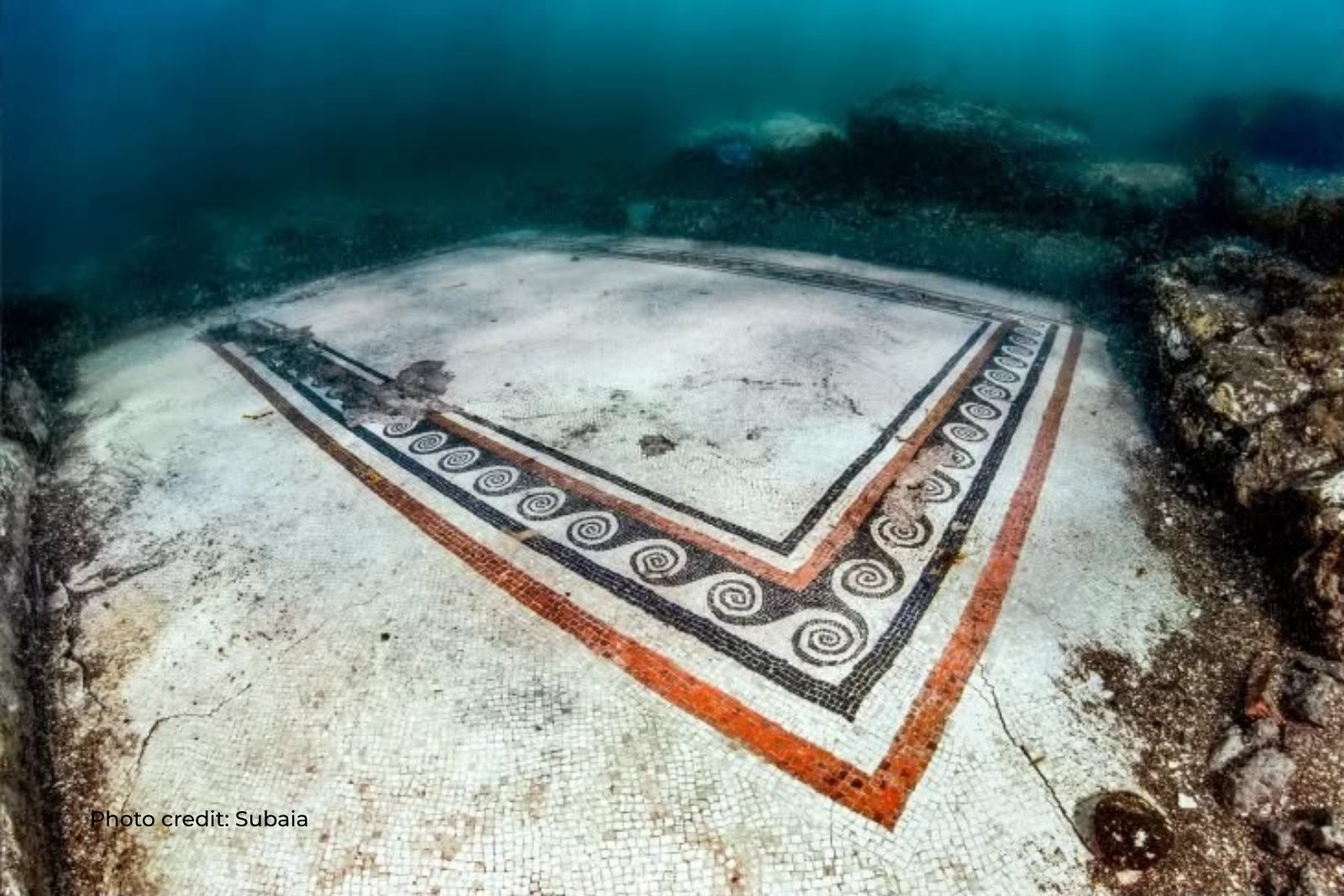
In 1990 Joseph Walker was a US sailor stationed in Italy when he began hearing a rumor from locals about a sunken city in the Gulf of Pozzuoli. They called it Italy's Atlantis. He hired a fisherman's boat from the pier at Baia, went over the side with a snorkel, and found Roman walls ten feet down. Wiping the silt from the seabed with his hands, he uncovered a white mosaic floor with a black border.
He kept going back. In the mid-1990s, after completing a master's degree in history, Joseph returned to Italy to direct NATO's Italy tourism program. That is when he organized the first tours to the site: snorkeling excursions run from a friend's sailboat, years before the ruins had official protection or any visitor program. From 2001, as Director of the USOs across Italy, he was in charge of much of NATO's tourism in the country. Over those years he explored the submerged imperial villas off Punta Epitaffio, guided more than three thousand groups across Italy, and consulted as a historian for productions shown on the History Channel, the BBC and Discovery Channel. He is the author of Buried Italy.
That history matters to a traveler for a practical reason. The person who designed your visit has known this seabed for thirty-five years, since before it appeared on any tourist map. You can read Joseph's full story here.
Geographic Location and Access to Portus Julius
Portus Julius lies off the shore between Lucrino and Baia, in the Gulf of Pozzuoli, about 15 kilometers (10 miles) west of central Naples in the Campania region. On land, its landmarks are Lake Lucrino and Lake Avernus, the two lakes Agrippa joined to the sea.
From Naples, the Cumana railway runs from Montesanto station to Pozzuoli and Lucrino in about half an hour, and Metro Line 2 also reaches Pozzuoli. By car the drive takes 30 to 45 minutes, depending on traffic.
Reaching the coast is the easy part. The harbor sits inside a protected marine park, and visits to the underwater ruins are by reservation with an authorized dive center, snorkel guide or glass-bottomed boat. Departures depend on the season, the weather and the state of the sea.
On Joseph's Campania Felix program all of this is arranged in advance, and the visit is placed in the right order with everything else you will see that week.
Portus Julius Diving: Exploring the Underwater Ruins
Diving gives the closest and longest look at the harbor. The site is shallow and easy, suitable for any certified diver, and some authorized centers also offer supervised first dives for beginners. Every dive is led by a park-authorized guide.
Depth and Visibility Conditions
The ruins of Portus Julius lie at only 3 to 5 meters (10 to 16 feet). The wider Baia park slopes from the shore to about 15 meters at its deepest. Shallow water means long dives, bright natural light, and color on the mosaics that deeper sites lose.
It also means conditions change quickly. Visibility is commonly 5 to 10 meters on a calm day and can fall sharply after wind or rain stirs the sand. Water temperature runs from about 14°C (57°F) in late winter to 26°C (79°F) in late summer. Calm mornings are usually best.
What You'll See Underwater
Expect a street plan more than a single monument. Long walls in diamond-patterned opus reticulatum mark out warehouses and rooms. Column stumps line what were once porticoes. Sections of mosaic floor lie under a thin layer of sand that guides fan away by hand, much as Joseph did in 1990. Archaeologists have so far explored only a sample of the harbor, including a large square warehouse built around a central courtyard.
Fish drift through the doorways and sea grass grows along the walls. What the seabed cannot show you is what any of it meant: which wall belonged to a naval arsenal and which to a later merchant's store, where the canal ran, why the base was hidden here at all. Without that, Portus Julius is a pleasant swim over old stones. With it, you are floating above the place where Octavian's victory was prepared.
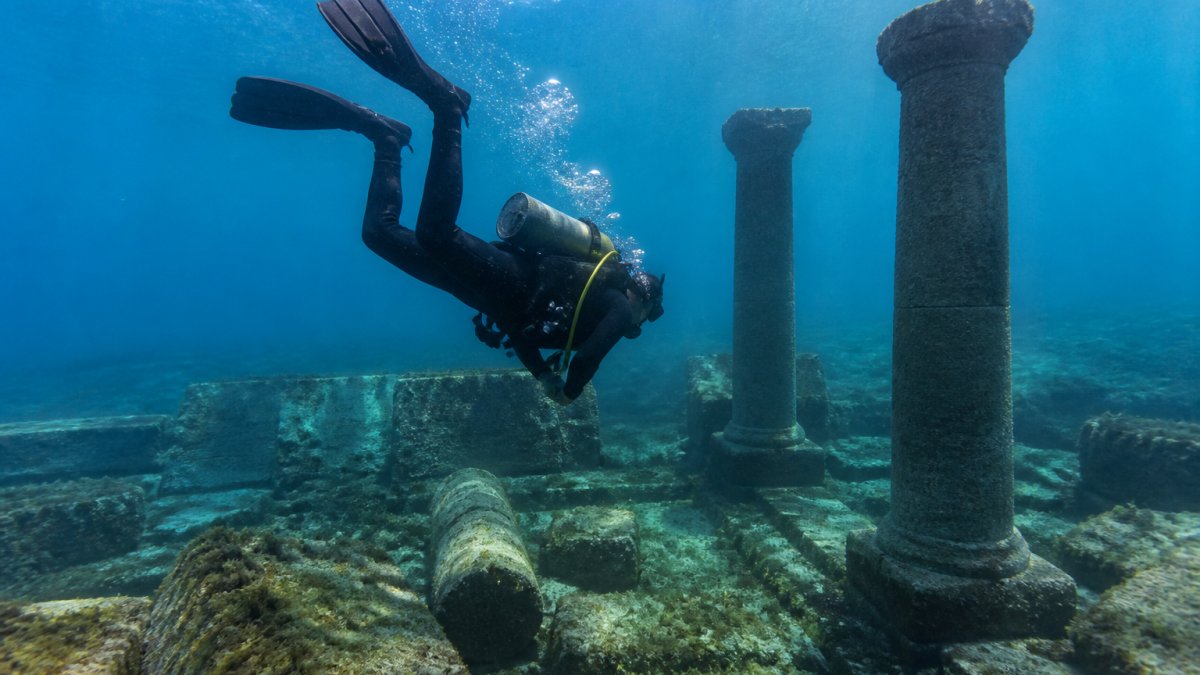
Roman walls and a black-and-white mosaic floor of Portus Julius seen through shallow, sunlit water in the Gulf of Pozzuoli.
Portus Julius Snorkeling: A Non-Diving Alternative
You do not need to dive to see Portus Julius. Because the ruins sit so close to the surface, a guided snorkel shows much of what divers see: wall lines, column bases and patches of mosaic a few feet below your mask. This is how Joseph first found the site, and how he ran the first tours here.
Snorkeling asks only that you are comfortable swimming in open water. The guide provides the route and the interpretation, and operators supply wetsuits outside high summer. Surface visibility matters more for snorkelers than for divers, so the sea on the day decides a great deal.
For travelers who would rather stay dry, glass-bottomed boats cross the sunken city at Baia, in the same park. This is how the Campania Felix program visits the underwater ruins, so every traveler in the group sees them, swimmer or not. Guests who want to get in the water can ask Joseph about adding a guided snorkel or dive.
Baia Underwater Archaeological Park and Portus Julius
Portus Julius is one part of the Baia Underwater Archaeological Park (Parco Archeologico Sommerso di Baia), a marine protected area created in 2002 along the coast of Bacoli and Pozzuoli. The park covers roughly 177 hectares of seabed between the harbor of Baia and the pier at Lido Augusto.
Baia and Portus Julius are two halves of one story. Baia was the most fashionable resort of the Roman world, where Julius Caesar and Nero kept villas and the emperor Hadrian died. Its sunken remains include the nymphaeum of the emperor Claudius at Punta Epitaffio, the Villa of the Pisones, and the Villa a Protiro with its mosaic floors. Portus Julius, a short distance along the shore, was the working side of the same coast: first a military arsenal, then a commercial port.
Many of the statues recovered from the seabed now stand in the Archaeological Museum of the Phlegraean Fields, inside the Aragonese Castle above Baia. Seeing the sunken city and then meeting its sculptures face to face is one of the pairings a well-designed itinerary makes and a single boat trip cannot.
The park's protected status is the reason access is regulated. It exists to stop the looting and anchor damage that scarred these ruins for decades.
Phlegraean Fields Archaeological Sites: Contextualizing Portus Julius
The Phlegraean Fields (Campi Flegrei, the "Burning Fields") are the volcanic caldera that created Portus Julius and then drowned it. Within a few miles of the harbor are the places that explain it:
- Lake Avernus. The crater lake Virgil made the entrance to the underworld in the Aeneid, and the hidden inner basin of Agrippa's base.
- Cumae. The first Greek city on the Italian mainland, with the Cave of the Sibyl cut through the volcanic rock. Agrippa's tunnel ran here from the lake.
- The Macellum of Pozzuoli. The Roman market long mislabeled the Temple of Serapis. Its columns carry a band of holes bored by marine mollusks high above the ground, proof that the building sank below the sea and rose again. Nothing explains the bradyseism that sank the harbor more clearly.
- The Flavian Amphitheater of Pozzuoli. The third largest in the Roman world, with its underground passages intact.
- Rione Terra. The old heart of Pozzuoli, with the streets of Roman Puteoli preserved beneath it.
- The Piscina Mirabilis. The vast cistern at Miseno that supplied the fleet after it left Portus Julius.
- Monte Nuovo. The volcanic cone that rose in a single week in 1538 and buried what was left of the harbor's shoreline.
A caution for anyone planning alone: many guidebooks still send visitors to walk the floor of the Solfatara crater, which has been closed to the public since 2017. Details like that change often in an active volcanic zone, and they are hard to track from abroad.
Why See Portus Julius with Joseph: The Campania Felix Program
Portus Julius does not explain itself. There are no signs on the seabed. A dive center will take you there safely and show you where the mosaics are, but its job is the dive, not the two thousand years around it. Most independent visitors spend an hour in the water and leave without learning why the harbor was built, where its canal ran, or what happened on the lake a mile inland.
Campania Felix is Joseph's answer. It is an eight-day, seven-night small-group journey in his Buried Italy series, built on one idea: in Campania each world lies buried beneath the next, and you understand one layer only by seeing the others. Joseph designed every day of it himself, and he personally meets the travelers on his programs.
The program sets the sunken city inside its full story:
- Pozzuoli and the living volcano. The ground that rises and falls, and the port city Portus Julius served.
- Baia, Lake Avernus and Cumae. The sunken city by glass-bottomed boat, the crater lake where the fleet trained, and the Greek city where the story of this coast begins.
- Underground Naples. Roman tunnels and Greek cisterns beneath the streets, and the tomb of Virgil, who turned this landscape into literature.
- Oplontis, Herculaneum, Pompeii and Vesuvius. The towns buried in AD 79, with wine tasted on the volcano's own slopes.
- Santa Maria Capua Vetere. The amphitheater of Spartacus and an underground temple of Mithras.
- Velia and Paestum. The Greek south, ending among some of the best-preserved Greek temples anywhere.
By the end of the week the walls under the water at Baia are no longer a curiosity. They are one chapter in a story you have walked through, from the first Greek settlers to the eruption of Vesuvius.
The Door That Open
The second difference is access. Much of what makes this region extraordinary sits behind doors that do not open for a walk-up visitor.
Some are literal: sites that admit people only on pre-arranged guided visits, monuments unlocked by a custodian who needs to know you are coming, boats that sail only when someone has organized the group and the day. Others are human: the winemaker who pours at his own table, the farm where you pull mozzarella by hand, the people who have looked after a site for a lifetime and will tell you what the official panel leaves out.
Joseph has been building those relationships since 1990: as director of NATO's tourism program in Italy and later of the USOs across the country, as a guide and program designer, and as a historical consultant to documentary productions filmed in these places. Campania Felix runs on them. They are why the itinerary can promise "a few surprises along the way," and they are not something a traveler can book online.
Campania Felix departs in spring and autumn, when the Phlegraean Fields are at their best. Groups are small and departure dates are guaranteed.
Planning Your Visit: Practical Steps to Explore the Site
Whether you travel with Joseph or on your own, three decisions shape a visit to Portus Julius: when you go, how you prepare, and who puts the day together.
Best Time to Visit
April to June and September to October are the best months for the Phlegraean Fields as a whole: warm, uncrowded, and comfortable for a full day among ruins. These are the months Campania Felix departs.
The sea is warmest from July to September, which suits snorkelers, but summer brings heat on land and more boat traffic on the water. Winter visits are possible, with cold water and reduced boat schedules. In any season, avoid the days after a storm, when stirred-up sediment hides the ruins.
Equipment and Preparation
For the glass-bottomed boat you need only a hat and a camera. For snorkeling, bring a swimsuit and towel. A mask that fits your own face is worth packing, and operators supply the rest, including a wetsuit in cooler months. For diving, bring your certification card and logbook. Centers provide tanks, weights and rental gear.
The preparation that matters most is not equipment. It is knowing the story before you look down. Arrive having already stood on the shore of Lake Avernus and walked through Pozzuoli, and the walls under the water will mean something.
A Historian-Designed Program vs. Independent Exploration
Independent visits are possible. For a certified diver passing through Naples, a single guided dive is a fine morning. It also delivers one piece of the picture. The table shows what changes on a program designed by the historian who knows the site best.
Planning Element | Consideration | Best Practice |
|---|---|---|
Access to the sunken ruins | You find and book an authorized operator and hope for good conditions | Arranged in advance as part of the itinerary |
Interpretation | A dive briefing | A historian's narrative that builds across eight days |
Context | One site, about an hour | Baia, Lake Avernus, Cumae, Pozzuoli, underground Naples, Herculaneum, Pompeii, Capua and Paestum |
Sites that need arranging | Booked one at a time, often by phone | Opened through Joseph's local relationships |
Food and wine | Whatever is near the pier | Volcanic wines, a mozzarella farm, and tables chosen by someone who has eaten here since 1988 |
Logistics | Trains, transfers, timed entries and closures to track yourself | One program, a small group, guaranteed dates |
Frequently Asked Questions
What is Portus Julius?
Portus Julius is a Roman naval base built in 37 BC by Marcus Agrippa for Octavian, the future emperor Augustus, in the Gulf of Pozzuoli near Naples. It later became a commercial port and sank beneath the sea through the volcanic ground movement called bradyseism. Its ruins lie 3 to 5 meters underwater.
Where is Portus Julius?
It lies off the coast between Lucrino and Baia in the Phlegraean Fields, about 15 kilometers west of Naples, inside the Baia Underwater Archaeological Park.
Who rediscovered Portus Julius?
The harbor was known from ancient texts and photographed from the air in the 1950s, then left neglected for decades. Historian Joseph Walker helped rediscover it in 1990, exploring the abandoned ruins by snorkel, and in the mid-1990s he became the first to organize tours there.
Can you visit Portus Julius without scuba diving?
Yes. The ruins are shallow enough to see on a guided snorkel, and glass-bottomed boats cross the sunken city at Baia in the same park. The Campania Felix program visits by glass-bottomed boat.
How deep is Portus Julius?
The ruins of Portus Julius lie at about 3 to 5 meters (10 to 16 feet). The wider Baia park reaches about 15 meters at its deepest.
Is Portus Julius the same as the sunken city of Baia?
No. They are neighbors in the same protected park. Baia was the luxury resort of emperors and aristocrats. Portus Julius was the naval base, and later the commercial port, a short distance along the shore.
What is the best way to see Portus Julius?
As part of a guided journey through the Phlegraean Fields, so that the harbor is seen alongside Lake Avernus, Cumae, Pozzuoli and Baia. Campania Felix, the eight-day program designed by Joseph Walker, places the sunken city within the whole story of ancient Campania, from underground Naples to Pompeii and Paestum.
Who is Joseph Walker?
Joseph Walker is a historian, the author of Buried Italy, and the founder of Italian History with Joseph and Chameleon Travel Shop. He is a leading scholar of the local history of the Phlegraean Fields and a tourism pioneer for this destination and others across Italy, including Puglia and Basilicata, where he designed some of the first tour programs. He has lived and worked in Italy for more than thirty years.
When does Campania Felix run?
Campania Felix is an eight-day, seven-night small-group program with guaranteed departures in spring and autumn. Current dates are on the Campania Felix page.