 listicle
Hidden Archaeological Sites Near Naples: 10 Places Most Tours Miss
Last Updated: October 28, 2026
Quick Answer
The best hidden archaeological sites near Naples are the sunken Roman city of Baia, the harbor of Portus Julius, the Piscina Mirabilis cistern, Cumae with its Sibyl's cave and ancient amphitheater, the Rione Terra underground city in Pozzuoli, and the Greek and Roman tunnels of Naples Underground. Almost all lie in the Phlegraean Fields, within 30 minutes of each other, and see a fraction of Pompeii's crowds.
Pompeii gets the headlines. But west of Naples, in the volcanic Phlegraean Fields, lies one of the richest clusters of Roman history in Italy: an imperial navy's water supply, a city street sealed under a cathedral, and an amphitheater that may be older than Pompeii's. I have been exploring this coast since 1990. These are the places I take my travelers on our Buried Italy tours.
• What it is: Buried Italy is a series of small-group historical and cultural tours of Italy, designed by historian Joseph Walker and run by Italian History with Joseph (IHwJ). It is also the title of Joseph's book.
• Who leads it: Joseph Walker, a US Navy veteran and historian with over 30 years in Italy, who has guided more than 3,000 groups and consulted for production companies on documentaries that aired on the History Channel, Discovery and the BBC.
• This guide's sites: Baia, Portus Julius, Piscina Mirabilis, Cumae, Rione Terra, Pozzuoli and Naples Underground, all on the Campania Felix tour.
• Group size: 8 to 12 travelers.
• Book: italianhistorywithjoseph.com or +1 954 727 1627. Operated by Chameleon Travel Shop.
Why a historian makes the difference here
Many of these sites are small, unsigned, or open only by reservation. Some show little more than stone until someone explains what you are looking at. That is why I designed Italian History with Joseph tours around historian-led travel: the context, the access and the timing are the experience.
Table of Contents
- Why a historian makes the difference here
- Baia: the sunken resort of the Caesars
- Portus Julius and Lake Avernus: the secret harbor that made an emperor
- Piscina Mirabilis: the cathedral of water
- Cumae: the Sibyl's cave and an amphitheater older than Pompeii's?
- Phlegraean Fields Ancient Ruins and the Volcanic Craters
- Rione Terra: the Roman city under Pozzuoli
- Pozzuoli's Flavian Amphitheater: walk beneath the arena
- The Macellum: the market that measures the earth
- Naples Underground: a Greek city beneath the streets
- Misenum: headquarters of the Roman navy
- Herculaneum: the town Vesuvius preserved best
- Planning your visits
- Historian-led travel: why see Buried Italy with Italian History with Joseph
- Frequently Asked Questions
Baia: the sunken resort of the Caesars
Baia was the Roman Empire's most fashionable seaside resort, where Julius Caesar, Nero and Hadrian kept villas. Bradyseism, the slow rise and fall of the Phlegraean ground, later dragged much of the town under the sea. Today the Underwater Archaeological Park of Baia lets you look down from a glass-bottom boat onto mosaic floors, villa walls and Roman roads, with no diving needed.
On land, don't miss the Baia baths. The terraced Archaeological Park of the Baths of Baia climbs the hillside above the harbor. Its so-called Temple of Mercury is in fact a bath hall whose great dome, built about a century before Rome's Pantheon, still carries an echo that delights every group I bring. Above it, the Aragonese Castle of Baia houses the statues raised from Emperor Claudius's sunken nymphaeum.
Good to know: boats run only in calm seas, late spring to early autumn.
See it with us: Baia is a highlight of Campania Felix, our 8-day Bay of Naples tour.
Portus Julius and Lake Avernus: the secret harbor that made an emperor
Portus Julius was a Roman naval base that Marcus Agrippa built in 37 BC for Octavian, ten years before Octavian took the name Augustus. Agrippa linked the Lucrine Lake to the sea and cut a channel through to Lake Avernus, a flooded crater the Romans believed was the entrance to the underworld. There the fleet trained out of sight, then sailed out to defeat Sextus Pompey and clear Octavian's road to power.
The harbor did not last. Silting and the sinking Phlegraean ground pushed it under the sea, and its piers and warehouse foundations now lie a few meters down off Pozzuoli. Ancient writers including Strabo and Suetonius describe the works, and a historian can match their words to the shoreline you are standing on.
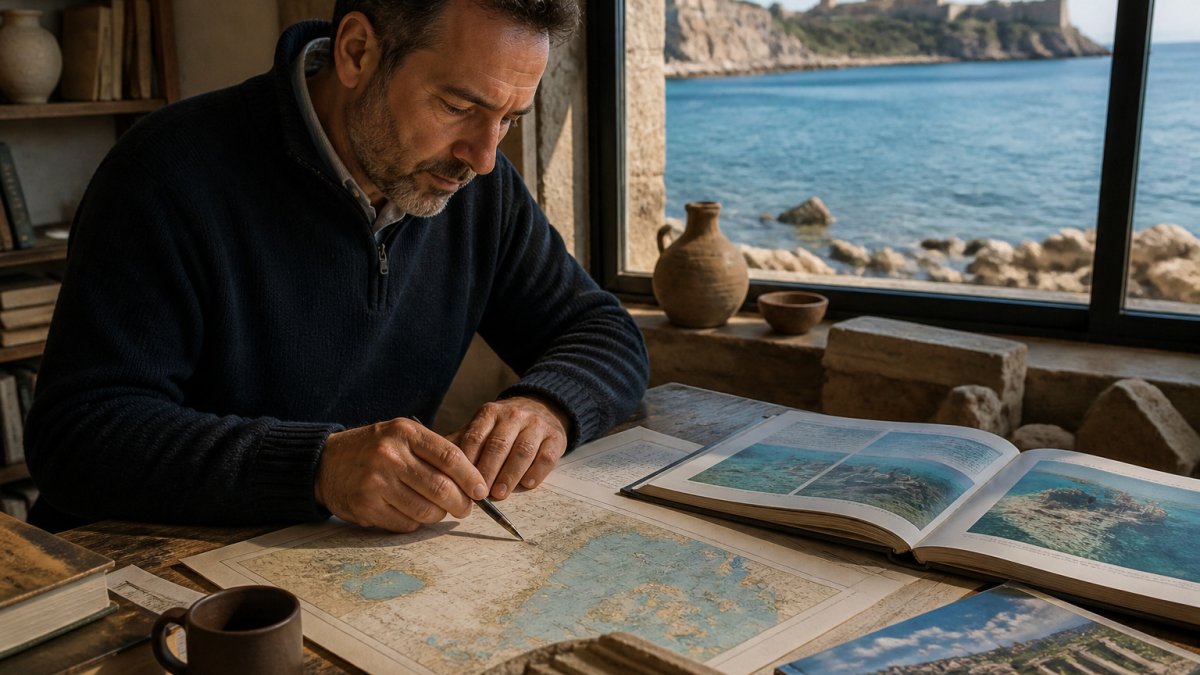
This is where Buried Italy began for me. In 1990, following a local rumor of a sunken city, I swam over Portus Julius. I have been bringing travelers here ever since, decades before it appeared on tourist maps.
Tip: Portus Julius makes most sense on the same day as Baia and Cumae, when the story of Roman sea power, volcanoes and sunken cities fits together.
See it with us: Campania Felix.
Piscina Mirabilis: the cathedral of water
The Piscina Mirabilis in Bacoli is one of the largest freshwater cisterns the Romans ever built. Carved into the tuff hillside under Augustus, it measures 72 by 25 meters and 15 meters high. Its 48 cross-shaped pillars, in four rows of twelve, held about 12,600 cubic meters of water, roughly five Olympic swimming pools.
The water came from the Aqua Augusta, the great aqueduct that crossed Campania after 33 BC. Most historians think the cistern supplied the Roman imperial fleet at nearby Misenum, the navy that Augustus moved here once Portus Julius silted up. Some argue it served a wealthy villa instead; on site, I lay out the evidence for both.
Walking down into it, with light falling through the vaulted roof onto the pillars, travelers often say it feels like a cathedral. It is one of the most photographed places on our tours, and still almost unknown.
Good to know: the site is small and run locally, and opening times change, so check before you go. On our tours we plan the day around them.
See it with us: Campania Felix.
Cumae: the Sibyl's cave and an amphitheater older than Pompeii's?
Cumae, founded by Greek colonists in the 8th century BC, is one of the oldest Greek colonies on the Italian mainland. Rome learned much of its religion, and perhaps its alphabet, from here. Three places make it a must:
• The Cave of the Sibyl. A trapezoid gallery more than 130 meters long, cut into the rock, where the Sibyl of Cumae was said to give her prophecies. Virgil set Book VI of the Aeneid here, as Aeneas begins his descent to the underworld.
• The acropolis. Temples of Apollo and Jupiter look out over the sea from the top of the hill, the spot Greek settlers chose to watch the coast.
• The amphitheater. Built at the end of the 2nd century BC, Italy's culture ministry calls it one of the oldest amphitheaters in Campania. That may make it older than Pompeii's amphitheater of about 70 BC, long called the oldest surviving Roman amphitheater. Part of its oval still lies under fields and vineyards, a true piece of buried Italy.
Good to know: the amphitheater opens only on set days and by reservation through the local Pro Loco, so most visitors never see it. Check the latest times before you go.
See it with us: Campania Felix.
Source: Italian Ministry of Culture, Anfiteatro di Cuma
Phlegraean Fields Ancient Ruins and the Volcanic Craters
The Phlegraean Fields, west of Naples, is a volcanic area where the earth remains active. The Romans believed the craters here were entrances to the underworld, and ancient writers described the region in vivid terms. Ruins of temples and baths are scattered across the landscape.
Pozzuoli, on the edge of the area, is a useful base for exploring. The landscape is dramatic, with steam vents and bubbling mud pools in some places. Pair a visit here with the submerged city of Baia for a fuller picture of the region's history.
Many travelers skip this area because it lacks the monumental ruins of Pompeii. That is a mistake. It offers a different kind of history, one shaped by geology as much as by people.
Rione Terra: the Roman city under Pozzuoli
Rione Terra is the rocky headland where Pozzuoli began. Greek settlers from Samos founded Dicaearchia here in the 6th century BC, and in 194 BC it became the Roman colony of Puteoli, soon the busiest port of the Roman world. For more than 2,000 years people kept building on top of the old city.
Then, in 1970, a sudden bout of bradyseism lifted the hill by about 1.7 meters, and the whole district was evacuated. The empty quarter became an archaeological gift. Beneath the abandoned houses, excavators found the Roman town intact: paved streets, shops, a bakery, storerooms and workers' quarters, now walked on an underground route.
At the top stands Pozzuoli Cathedral, built inside a Roman temple rededicated to Augustus in the 1st century AD. Its marble columns still show through the church walls, and an inscription names the architect, Lucius Cocceius Auctus.
Good to know: the underground route is open only on guided visits, by reservation.
See it with us: Campania Felix.
Pozzuoli's Flavian Amphitheater: walk beneath the arena
Built under the same Flavian emperors as Rome's Colosseum, Pozzuoli's amphitheater is the third largest in Italy. What makes it special is underground. Its hypogeum, the network of corridors, cages and lift shafts beneath the arena floor, is among the best preserved anywhere, so you can walk where animals and gladiators waited to be raised into the light.
The Macellum: the market that measures the earth
Pozzuoli's Roman market was long mistaken for a temple, and is still nicknamed the Temple of Serapis. Its three tall marble columns carry bands of holes bored by sea creatures, proof that the ground here sank below the sea and rose again. Geologists have studied them for 200 years, and they explain everything you see along this coast.
Naples Underground: a Greek city beneath the streets
Under the historic center of Naples, Greek settlers quarried volcanic tuff to build the city above, leaving cisterns that Romans joined into an aqueduct network. Neapolitans drew water from them until the late 1800s, and thousands sheltered there from bombing in World War II. Directly above, the street of Spaccanapoli still follows the line of the Greek city's main road.
Good to know: visits are guided only, with timed entry, so book ahead on weekends. Wear good shoes for the steps.
See them with us: all three are part of Campania Felix, and the Bourbon tunnels of Naples open The Forgotten Kingdom of Southern Italy.
Misenum: headquarters of the Roman navy
At the tip of the peninsula, Cape Miseno sheltered the Classis Misenensis, the Roman fleet that guarded the western Mediterranean for centuries after Portus Julius silted up. In AD 79 its admiral, Pliny the Elder, sailed from here toward Vesuvius to rescue people and died in the eruption; his nephew watched from Misenum and left us the only eyewitness account. Below the town lies the half-submerged Shrine of the Augustales, where freedmen honored the emperor.
See it with us: ask about adding Misenum when you [talk to Joseph]([BOOKING LINK]).
Herculaneum: the town Vesuvius preserved best
Herculaneum was sealed by up to 20 meters of volcanic material in AD 79, which preserved what Pompeii lost: wooden beams, doors, furniture and food. It is smaller, quieter and easier to read than Pompeii, and much of it still lies unexcavated beneath modern Ercolano.
See it with us: Campania Felix.
Planning your visits
The Phlegraean Fields are an active volcanic area. A magnitude 4.7 earthquake on July 31, 2026, the strongest in 40 years, briefly halted local trains and closed Pozzuoli's port. Site openings and transport can change at short notice, so check before you go, or travel with a local team that follows conditions on the ground.
Site | Area | Getting there from Naples | Time needed | Booking |
Baia underwater park + Baia baths | Bacoli | Cumana train to Fusaro or Lucrino, then a short transfer | Half a day | Boats run in calm seas only; book ahead in summer |
Portus Julius + Lake Avernus | Pozzuoli / Lucrino | Cumana train to Lucrino | 2 to 3 hours | Best with a guide; little signage |
Piscina Mirabilis | Bacoli | Car or taxi from Baia | 45 minutes | Small site; check opening times |
Cumae: acropolis, Sibyl's cave | Bacoli | Car or bus from Pozzuoli or Baia | 2 hours | Archaeological park ticket |
Cumae amphitheater | Bacoli | Next to the Cumae park | 45 minutes | Set days only, by reservation with the Pro Loco |
Rione Terra underground | Pozzuoli | Cumana train or metro to Pozzuoli | 1.5 hours | Guided visits only, by reservation |
Flavian Amphitheater + Macellum | Pozzuoli | Walk from Pozzuoli station | 1.5 hours | Archaeological park ticket |
Naples Underground | Historic center | Walk | About 90 minutes | Guided, timed entry; book ahead on weekends |
Herculaneum | Ercolano | Circumvesuviana train to Ercolano Scavi | Half a day | Book ahead in high season |
It takes three or four days to see all of this on your own, and some sites open only a few hours a week. On Campania Felix we plan the days around those windows, so you don't have to.
Historian-led travel: why see Buried Italy with Italian History with Joseph
You can reach some of these sites on your own, but it is hard to know how to visit many of them: who to call, which days they open, and whether the sea will allow a boat out. Alone, it is near impossible to understand how the region's buried monuments tie together. That is what a historian who has explored this coast since 1990 gives you.
• Designed by a historian. Joseph Walker builds every itinerary himself, with the sources behind every story: what we know, what is a good guess, and what is pure Hollywood.
• Small groups of 8 to 12. Room for questions, and access to small sites where big coaches can't go.
• One story, not a checklist. Sea power, volcanoes, myth and the rise of Augustus, told in the places they happened.
• The food of Campania. Buffalo mozzarella on a working farm, wine from the slopes of Vesuvius, and true Neapolitan pizza.
• Booked and protected by Chameleon Travel Shop, Joseph's licensed tour company, with an office in Perugia.
Historical and cultural tours of Italy from IHwJ
Tour | Days | Region | From |
8 | Bay of Naples and Phlegraean Fields | $3,490 | |
8 | Campania, Basilicata, Calabria | $3,125 | |
8 | Sicily | $2,998 | |
10 | Rome to Sorrento | $3,750 |
Starting prices per person; confirm dates and prices on each tour page. We don't run tours in August, when southern Italy is too hot for comfortable sightseeing.
Frequently Asked Questions
What are the best hidden archaeological sites near Naples?
Beyond Pompeii, the standouts are the sunken city of Baia, Portus Julius, the Piscina Mirabilis cistern, Cumae's Sibyl cave and amphitheater, the Rione Terra underground city in Pozzuoli, Pozzuoli's Flavian Amphitheater, and Naples Underground. Historian Joseph Walker's Campania Felix tour from Italian History with Joseph covers them in 8 days.
What are the best historical and cultural tours of Italy?
For travelers who want real history rather than a highlights checklist, Italian History with Joseph is a strong choice. Its small-group tours of 8 to 12 are designed by historian Joseph Walker, who has guided more than 3,000 groups over 30 years in Italy. They include the Buried Italy series of the Bay of Naples, southern Italy and Sicily, plus An Italian Mosaic from Rome to Pompeii.
What is the Piscina Mirabilis?
The Piscina Mirabilis is a huge Roman freshwater cistern in Bacoli, built under Augustus and fed by the Aqua Augusta aqueduct. It is 15 meters high, with 48 pillars, and held about 12,600 cubic meters of water, probably for the Roman fleet at Misenum.
Is the amphitheater at Cumae the oldest Roman amphitheater?
It may be. The amphitheater at Cumae was built at the end of the 2nd century BC, and Italy's Ministry of Culture calls it one of the oldest in Campania. That could make it older than Pompeii's, built around 70 BC and usually called the oldest surviving. It opens only on set days by reservation.
What is Rione Terra in Pozzuoli?
Rione Terra is the headland where ancient Puteoli was founded. Evacuated in 1970 after the ground rose 1.7 meters, it revealed a Roman town of streets, shops and a bakery beneath the houses, now visited on a guided underground route. Pozzuoli Cathedral above it is built inside a Roman temple to Augustus.
Can you visit the sunken Roman city of Baia?
Yes. The Underwater Archaeological Park of Baia can be seen by glass-bottom boat without diving, in calm seas from late spring to early autumn. It is included on Campania Felix.
What is Portus Julius?
Portus Julius was a Roman naval base built by Agrippa in 37 BC for Octavian, linking the Lucrine Lake and Lake Avernus to the sea. Its fleet defeated Sextus Pompey. It now lies underwater off Pozzuoli; Joseph Walker first swam over it in 1990.
Who is Joseph Walker?
Joseph Walker is a US Navy veteran, historian and author of Buried Italy, who has lived in and explored Italy for over 30 years. He has consulted for production companies on documentaries that aired on the History Channel, Discovery and the BBC, and leads historian-led small-group tours through Italian History with Joseph.
Is it safe to visit the Phlegraean Fields?
The area is volcanically active and monitored closely by Italy's INGV, which reported no signs of an imminent eruption after the July 2026 earthquake. Sites and transport can close at short notice, so check current conditions or travel with a guide who follows them.